
TL;DR We write our papers in LaTeX, inside folders encrypted with EncFS on top of macFUSE, with VS Code rebuilding and refreshing the PDF preview on every save. One evening the encrypted volume froze so hard that even shutting down the Mac stalled, twice in fifteen minutes. In this post we walk through how we went from the macOS shutdown-stall reports to the root cause: since macFUSE 5.1.0, the libfuse handler for the new FUSE_MONITOR message takes a path lock and never releases it. A normal attach/detach cycle for a per-file kqueue watch generates a MONITOR BEGIN/END pair, and the affected handler leaks one read lock for each message. A later FORGET that drops the last lookup reference to a leaked node can then park a worker thread forever. An old accounting shortcut in libfuse leaves blocked FORGET workers counted as available, so enough such requests can exhaust the real worker pool without starting replacements. We show the bug in the source, confirm its affected release window in the binaries and source history, and reproduce the full freeze with a toy file system of a few hundred lines of C. The mechanism is demonstrated end to end; the shutdown-stall reports do not, however, identify which application created the original watches. The bug was already reported upstream (macfuse/macfuse#1168) and is fixed since macFUSE 5.3.1, so the short version is: update macFUSE. The long version is below :).
How It Started: a .tex, a PDF Preview, and a Frozen Mac
Our day-to-day paper writing is pretty boring, which is how we like it: .tex sources, VS Code with the LaTeX Workshop extension, latexmk building on every save, and the PDF preview tab refreshing itself a second later. The only slightly unusual part is where the sources live. Our research folders are encrypted with EncFS, and the ciphertext is synced to our own Nextcloud server (when it works). EncFS is a FUSE file system, so on macOS it runs on top of macFUSE: the kernel extension forwards operations that require user-space handling to the encfs process, which decrypts on the fly.
On November 5, 2026, in the middle of an evening of writing, everything that touched the encrypted folder stopped responding (this was happening us few weeks ago, but we did not have enough time to dig into it until now…). The editor hung, terminals hung on ls, and diskutil unmount did not help. We rebooted. Eleven minutes after remounting the folder and getting back to work, it happened again. Second reboot.
Two freezes in fifteen minutes is not bad luck, it is a bug. And since the Mac kept forensic breadcrumbs of both incidents, we went digging (well, spoiler here: the culprit is a missing free_path() call, otherwise you would not be reading this).
First Clues: Reading the Shutdown-Stall Reports
When macOS takes too long to shut down, launchd records a shutdown stall report in /Library/Logs/DiagnosticReports/. These reports are binary spindumps, but spindump itself can turn them into text:
spindump -i /Library/Logs/DiagnosticReports/shutdown_stall_2026-11-05-215306_atropos.shutdownStall -o stall1.txtEach report contains the stack of every thread of every process still alive while the system was trying to shut down. Of course, the encfs processes were there. Figure 1 shows the process serving our research folder: the main thread waits in the libfuse session loop, as expected, while every worker thread sits on exactly the same stack. Note the last ran column: one worker had not run for 38 hours, another for 21 hours, and the rest had stopped at the same instant, less than three minutes before the shutdown.
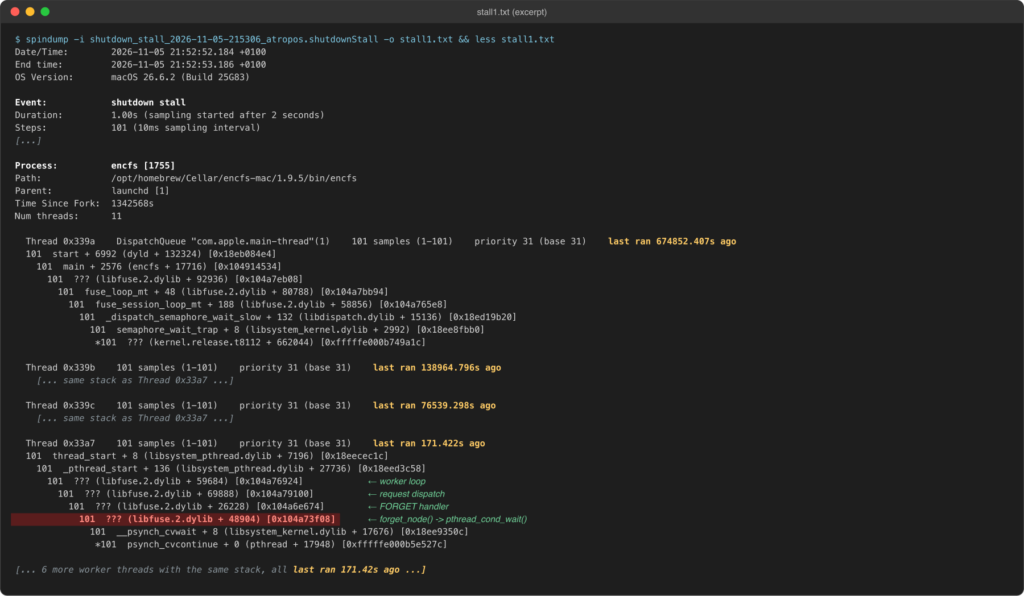
Figure 1: Excerpt of the decoded shutdown-stall report: the encfs process serving our research folder (annotations ours).
The library is stripped, but the arm64 slice of libfuse.2.dylib disassembles nicely with otool -arch arm64 -tV. The four libfuse offsets in the worker stack (59684, 69888, 26228 and 48904, that is, 0xe924, 0x11100, 0x6674 and 0xbf08) are, respectively, the worker loop right after fuse_session_process_buf(), the request dispatcher, a small handler that prints "FORGET %llu/%llu\n" in debug mode, and a pthread_cond_wait() inside the function that handler calls. In other words: every worker is processing a FORGET request and waiting on a condition variable.
And it was not alone. Counting threads across both reports:
| Report | encfs process | Workers waiting at 0xbf08 | Workers reading /dev/macfuse | Notes |
|---|---|---|---|---|
| 21:52 (first freeze) | research folder | 9 / 9 | 0 | 2 of them had been parked for 38 h and 21 h; the other 7 since 21:50:01 |
| 21:52 (first freeze) | second encrypted folder | 3 / 9 | 6 | 2 parked for ~37 h, 1 since 21:49: quietly heading the same way |
| 22:09 (second freeze) | research folder, remounted | 10 / 10 | 0 | all parked within 11 minutes of mounting |
So the workers were not stuck on I/O, on decryption, or on Nextcloud. They were waiting, one by one, for something that never came, and once the last one got in line, nobody was left to read requests from the kernel. Time to read some source code.
Into the Source: Path Locks in High-Level libfuse
EncFS uses the high-level FUSE API, where the file system receives paths (/papers/draft/paper.pdf) instead of inode numbers. To keep paths consistent while requests run concurrently, libfuse maintains an in-memory tree of nodes and a per-node lock counter, treelock: positive values count readers, -1 (TREELOCK_WRITE) marks a writer. macFUSE maintains its own fork of libfuse 2.9 in macfuse/library (branch support/libfuse-2.9), and the read-locking part of try_get_path() in lib/fuse.c looks like this:
for (node = get_node(f, nodeid); node->nodeid != FUSE_ROOT_ID;
     node = node->parent) {
	...
	if (need_lock) {
		err = -EAGAIN;
		if (node->treelock < 0)
			goto out_unlock;

		node->treelock++;
	}
}
Note the loop: a read lock on a path increments treelock on the node and on every ancestor directory up to (but not including) the root. Every get_path() must be paired with a free_path(), which walks the same chain decrementing the counters.
Now, the function our threads were stuck in. The FORGET handler calls forget_node():
static void forget_node(struct fuse *f, fuse_ino_t nodeid, uint64_t nlookup)
{
	...
	/*
	 * Node may still be locked due to interrupt idiocy in open,
	 * create and opendir
	 */
	while (node->nlookup == nlookup && node->treelock) {
		struct lock_queue_element qe = {
			.nodeid1 = nodeid,
		};

		debug_path(f, "QUEUE PATH (forget)", nodeid, NULL, false);
		queue_path(f, &qe);

		do {
			pthread_cond_wait(&qe.cond, &f->lock);
		} while (node->nlookup == nlookup && node->treelock);
		...
When the kernel asks the file system to drop the last lookup reference known to libfuse (node->nlookup == nlookup), forget_node() waits until nobody holds a path lock on that node. That pthread_cond_wait() is our 0xbf08. If treelock never goes back to zero, the thread never comes back. So the question becomes: who is leaking path locks?
The Bug: a MONITOR That Never Lets Go
macFUSE 5.1.0 (October 30, 2025) added support for a new macOS-specific message, FUSE_MONITOR (opcode 60), in commit 67aa41ee. The kernel sends it to tell the file system that the number of watchers of a file has changed (FUSE_MONITOR_BEGIN / FUSE_MONITOR_END). Here is the high-level handler as it shipped:
static void fuse_lib_monitor(fuse_req_t req, fuse_ino_t ino, uint32_t flags)
{
	struct fuse *f = req_fuse_prepare(req);
	char *path;
	int err;

	err = get_path(f, ino, &path);   /* read lock on the node and its ancestors */
	if (err) {
		fuse_reply_none(req);
		return;
	}

	fuse_fs_monitor(f->fs, path, flags);
	fuse_reply_none(req);            /* ...and no free_path(). Ever. */
}
There is a get_path() but no free_path(). Every MONITOR message leaves treelock incremented by one on the watched node and on each parent directory up to, but not including, the root. Two details make this worse than it looks:
- It does not matter whether the file system cares about monitoring. EncFS does not implement the
.monitoroperation (fuse_fs_monitor()simply does nothing), butfuse_lib_monitor()is registered unconditionally infuse_path_ops, so the lock is taken anyway. - A normal per-file watch lifecycle costs two leaks. To know where
VNOP_MONITORcomes from, we looked at XNU. Inbsd/vfs/vfs_vnops.c, the vnode kqueue attach path callsVNOP_MONITOR(vp, 0, VNODE_MONITOR_BEGIN, ...)after a filter is attached successfully, andfilt_vndetach()normally calls it again withVNODE_MONITOR_ENDwhen the filter goes away. macFUSE forwards both asFUSE_MONITOR. Thus a successful attach plus detach leaks two locks; either message by itself leaks one.
Who generates those per-file kqueue filters? Node.js documents that fs.watch() uses kqueue for files and FSEvents for directories on macOS. Against a test mount, fs.watch() on a single file produced exactly one MONITOR BEGIN/END pair, while fs.watch() on a directory and fs.watchFile() (polling) produced none. This proves a concrete trigger, but not the identity of the process that triggered our incident.
Our LaTeX workflow initially looked like the obvious suspect, but a closer check sets an important limit on that claim. The installed LaTeX Workshop 10.20.0 creates VS Code FileSystemWatchers from directory glob patterns, and normally refreshes the project PDF directly after a successful build. The shutdown-stall reports preserve thread stacks, not the process that originally installed the watches. We therefore cannot name the PDF preview—or even LaTeX Workshop—as the culprit from the surviving evidence. Another VS Code component or any other application using a per-file kqueue watch could have supplied the MONITOR traffic. What the reports, source analysis and PoC establish together is the failure chain once those stale path locks exist.
The fix, in commit c3ff8d98 (June 8, 2026), is literally one line:
 	fuse_fs_monitor(f->fs, path, flags);
+	free_path(f, ino, path);
 	fuse_reply_none(req);
From a Leaked Lock to a Frozen Volume
A leaked read lock has two visible effects. The first one is the symptom described in issue #1168: an operation that needs a write lock on the leaked node or path (unlink, rmdir, rename) finds treelock > 0, queues up, and waits forever. That is bad, but it consumes one thread per stuck request, and ordinary requests decrement numavail, allowing libfuse to start replacement workers.
The second effect matches the terminal mechanism in our shutdown-stall reports. When the kernel reclaims a vnode and sends a FORGET that drops its final lookup count (for example after cache reclamation, deletion or during unmount), forget_node() can park the worker forever on the leaked treelock. And here comes the second ingredient, which has been in upstream libfuse for years. In lib/fuse_loop_mt.c:
/*
 * This disgusting hack is needed so that zillions of threads
 * are not created on a burst of FORGET messages
 */
if (!(fbuf.flags & FUSE_BUF_IS_FD)) {
	struct fuse_in_header *in = fbuf.mem;

	if (in->opcode == FUSE_FORGET ||
	    in->opcode == FUSE_BATCH_FORGET)
		isforget = 1;
}

if (!isforget)
	mt->numavail--;
if (mt->numavail == 0)
	fuse_loop_start_thread(mt);
A worker handling a FORGET does not decrement numavail, an optimisation intended to avoid spawning many threads for a burst of one-way FORGET requests. With the leak, the request is no longer quick: each final FORGET on a leaked node can park one worker while the accounting still treats it as available. As long as the stale counter remains nonzero, no replacement is started. Once enough workers are parked, nobody reads /dev/macfuse anymore, and every operation that requires a request to the file system daemon—including unmount and shutdown work—waits forever. Figure 2 puts the whole chain together.
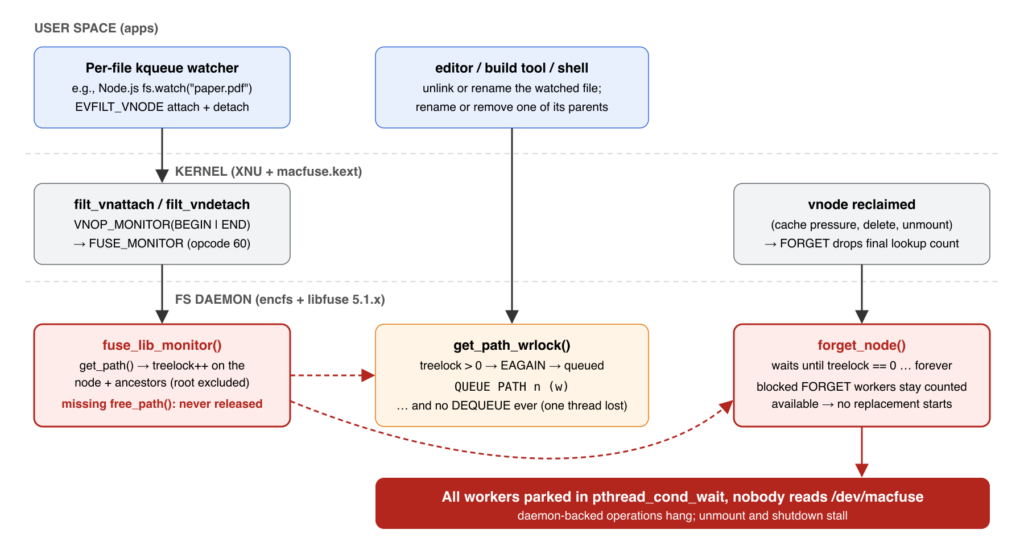
Figure 2: From a kqueue watch to a frozen FUSE volume.
This mechanism is also consistent with the timeline in the stall reports: a couple of workers had been parked over a day and a half of normal use, and then the remaining seven stopped within the same second during a busy writing session. The stacks prove where the workers ended up; the source history and PoC explain how the MONITOR leak can put them there.
Confirming It in the Binaries
Reading source is nice, but what runs on the machine is the binary. We downloaded the official packages from the macFUSE releases page, extracted libfuse.2.dylib with pkgutil --expand-full, and located fuse_lib_monitor() in the arm64 slice by following the calls to the exported fuse_fs_monitor() (the other callers are the stacking modules, such as iconv or volicon). This is the official version 5.1.3 binary—the version installed on the affected Mac—and its worker-stack offsets match those in the shutdown-stall reports (only the calls are shown):
abc8  sub  sp, sp, #0x40
abe8  bl   0xb9f0                   ; req_fuse_prepare()
ac00  bl   0xc068                   ; get_path()  -> read lock taken
ac14  bl   _fuse_fs_monitor
ac1c  bl   _fuse_reply_none         ; ...and that's it
And this is version 5.5.0, where free_path() has been inlined after the call:
b058  bl   0xbea4                   ; req_fuse_prepare()
b070  bl   0xc528                   ; get_path()
b084  bl   _fuse_fs_monitor
b094  bl   _pthread_mutex_lock      ; free_path(), inlined:
b0a8  bl   0xcb08                   ;   unlock_path()
b0b8  bl   0xcbe0                   ;   wake_up_queued()
b0c0  bl   _pthread_mutex_unlock
b0c8  bl   _free
b0d0  bl   _fuse_reply_none
Repeating the check on other releases gives the window of affected versions:
| macFUSE | Release date | FUSE_MONITOR handler | Lock released |
|---|---|---|---|
| 5.0.7 | 2025-09-30 | no | n/a |
| 5.1.0 | 2025-10-30 | yes | no |
| 5.3.0 | 2026-06-07 | yes | no |
| 5.3.1 | 2026-06-13 | yes | yes |
| 5.5.0 | 2026-10-17 | yes | yes |
We checked the binaries listed in the table directly. The introducing code landed before 5.1.0 and remained unchanged until the fix released in 5.3.1, which brackets the intermediate 5.1.1–5.2.0 releases as affected; a commenter on issue #1168 also independently reported the bug on 5.2.0. We confirmed in the 5.1.3 binary that the FORGET shortcut is present too: the worker loop compares the opcode against 0x2 (FUSE_FORGET) and 0x2a (FUSE_BATCH_FORGET) and skips the numavail decrement for both.
Reproducing the Freeze (Without Rebooting This Time)
The bug lives entirely in user space, inside libfuse.2.dylib, so there is no need to downgrade the kernel extension to reproduce it: a test file system linked against the old library runs fine on top of the current, fixed macFUSE. We wrote three small pieces:
memfs.c, a minimal in-memory high-level FUSE file system that, like EncFS, does not implement.monitor;kqwatch.c, which attaches and detaches anEVFILT_VNODEkqueue filter on each path it receives (i.e., it is a very boring file watcher);repro.sh, which mountsmemfswithlibfusedebug output (-d), runs each step under a hard timeout, and kills the file system withSIGKILLat the end, so a frozen mount cannot outlive the experiment.
The core of kqwatch is just this:
int fd = open(path, O_EVTONLY);
int kq = kqueue();
struct kevent ev;
EV_SET(&ev, fd, EVFILT_VNODE, EV_ADD | EV_CLEAR,
       NOTE_WRITE | NOTE_DELETE | NOTE_RENAME, 0, NULL);
kevent(kq, &ev, 1, NULL, 0, NULL);   /* attach -> MONITOR(BEGIN) */
close(kq);                           /* detach -> MONITOR(END)   */
close(fd);
Each scenario was run twice: once linked against libfuse 5.1.3 (affected) and once against the installed 5.5.0 (fixed). The leak scenario watches d/x three times and then deletes it; the wedge scenario watches 24 files once each and then unmounts the volume, which makes the kernel send one FORGET per file:
| Scenario | libfuse | MONITOR | FORGET | QUEUE PATH / DEQUEUE | Outcome |
|---|---|---|---|---|---|
| leak | 5.5.0 | 6 | 0 | 0 / 0 | rm completes |
| leak | 5.1.3 | 6 | 0 | 1 / 0 | rm hangs (killed after 10 s) |
| wedge | 5.5.0 | 48 | 24 | 0 / 0 | unmount completes |
| wedge | 5.1.3 | 48 | 4 | 4 / 0 | unmount hangs, all 4 workers parked, 0 reading /dev/macfuse |
The debug log of the leak run tells the story in a few lines (flags 1 and 2 are BEGIN and END):
unique: 4, opcode: MONITOR (60), nodeid: 3, insize: 48, pid: 90437
monitor /d/x 2
...
QUEUE PATH 3 (w)
There is no matching DEQUEUE PATH. In the wedge run, the file system had four workers alive, and the first four FORGETs took all of them:
unique: 50, opcode: FORGET (2), nodeid: 25, insize: 48, pid: 90614
FORGET 25/1
QUEUE PATH (forget) 25
...
The other 20 FORGETs and the final DESTROY were never read. The stacks of the parked workers, taken with sample, show the same return addresses we had found in the shutdown-stall reports of our real encfs: 0xe924 → 0x11100 → 0x6674 → 0xbf08. The PoC therefore reproduces the terminal worker-pool state on demand, although it cannot retrospectively identify the application that created the original watches. Good news for our blood pressure: after the driver timed out and killed the blocked rm or umount, killing the test file system with SIGKILL and force-unmounting recovered the mount point in every run; no reboot was needed.
Is This a Vulnerability?
The impact is a local denial of service. The most specific CWE mapping is CWE-764, Multiple Locks of a Critical Resource: every MONITOR takes the path lock again without the matching unlock. CWE-772, Missing Release of Resource after Effective Lifetime, also describes the missing release. We avoid CWE-833 here because its definition requires threads or executable segments waiting for each other; this failure is an indefinite wait on an abandoned lock count, not a circular deadlock. Creating a leaked lock requires only read access to a file on the volume: open(O_EVTONLY) plus a kqueue filter, with no special entitlement. One watched node is enough to wedge a later write-locking operation on that path; driving the whole volume into the worker-pool failure requires enough leaked nodes to reach final FORGETs. By default, macFUSE limits a volume to the user who mounted it, so in most setups the triggering software runs as that same user. With allow_other, any local user who can open suitable files on the volume can trigger the same denial of service for all its users. The bug was reported publicly in May 2026 and fixed in June 2026; we are not aware of a CVE assigned to it.
Takeaways
- Update macFUSE to 5.3.1 or later. If you installed it with Homebrew, note that the cask is marked
auto_updates, so a plainbrew upgradeskips it, and Homebrew may even report an outdated version. Usebrew upgrade --cask --greedy macfuse, or check the real version withdefaults read /Library/Filesystems/macfuse.fs/Contents/Info.plist CFBundleShortVersionString. - If a FUSE volume freezes, look at the threads of the file system process (
sample <pid> 1) before rebooting. Workers parked inpthread_cond_waitunder theFORGEThandler are consistent with an unreleased high-level path lock; check the macFUSE version and debug log forMONITORplusQUEUE PATH (forget)before attributing it to this specific bug.kill -9on the file system process followed byumount -fwas enough to recover in our tests. - Watchers are not free. A per-file kqueue watcher looks like a passive observer, but on macOS a successful attach and normal detach on a macFUSE vnode each become a round trip to the file system daemon—and, in the affected releases, a leaked path lock.
- The
FORGETshortcut is still there. The fix removes this leak, butfuse_loop_mt.cstill does not countFORGETworkers as busy. Another bug that leaves high-level path locks held could again escalate into a frozen volume if enough finalFORGETs block. A defensive fix (for instance, counting aFORGETworker as busy while it blocks inforget_node()) would make this failure mode much less dramatic.
And that’s all, folks! The PoC (toy file system, watcher, test driver, a script to check macFUSE releases at the binary level, and the debug logs of the runs above) is available on GitHub. Many thanks to the macFUSE maintainer and to the reporters of #1168, who had already done the hard part. If you are into file system internals, crash-report forensics, or reverse engineering stripped libraries, reach out to us. Thanks for reading, and stay secure (and keep your macFUSE updated)!
Declaration of Generative AI Technologies in the Writing Process
During the preparation of this post, the author used Claude (Claude Opus 5.5 model) to analyze the shutdown-stall reports, disassemble the libfuse binaries, build and run the reproduction, and improve readability and language. After using this tool, the author reviewed and edited the content as necessary and takes full responsibility for the content of this publication.
